


French specialist in hexagonal LED lighting. Robust equipment, fair prices, responsive service.
📞 +33 1 84 16 45 42
📧 support@hexeli.com
HELP & CUSTOMER SERVICE HELP & CUSTOMER SERVICE
Payment methods
In a showroom, you don't light the room: you light what you're showing. Drag the handle to see the difference it makes on a car body.
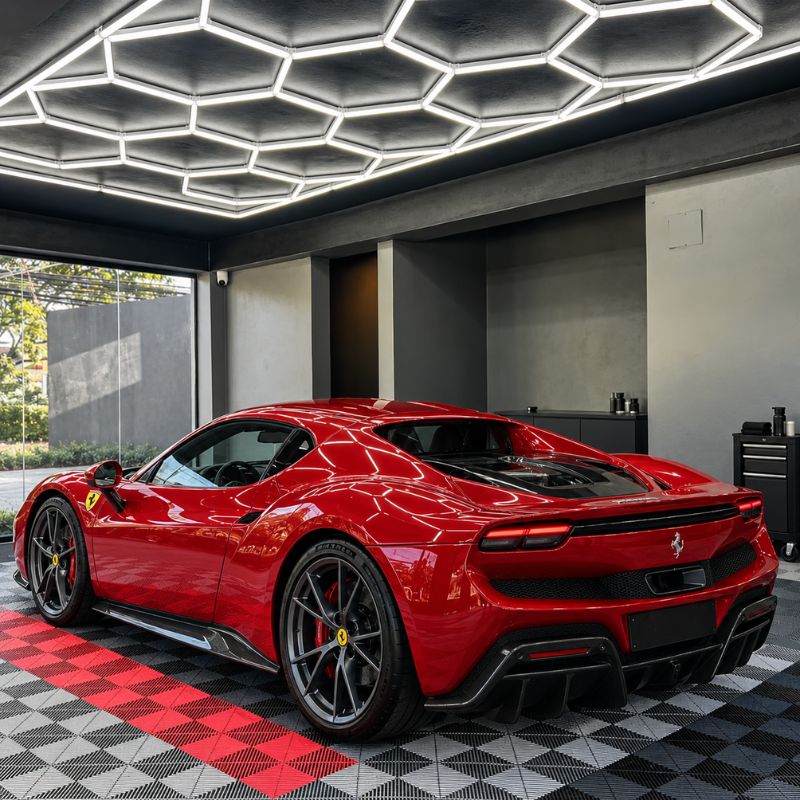
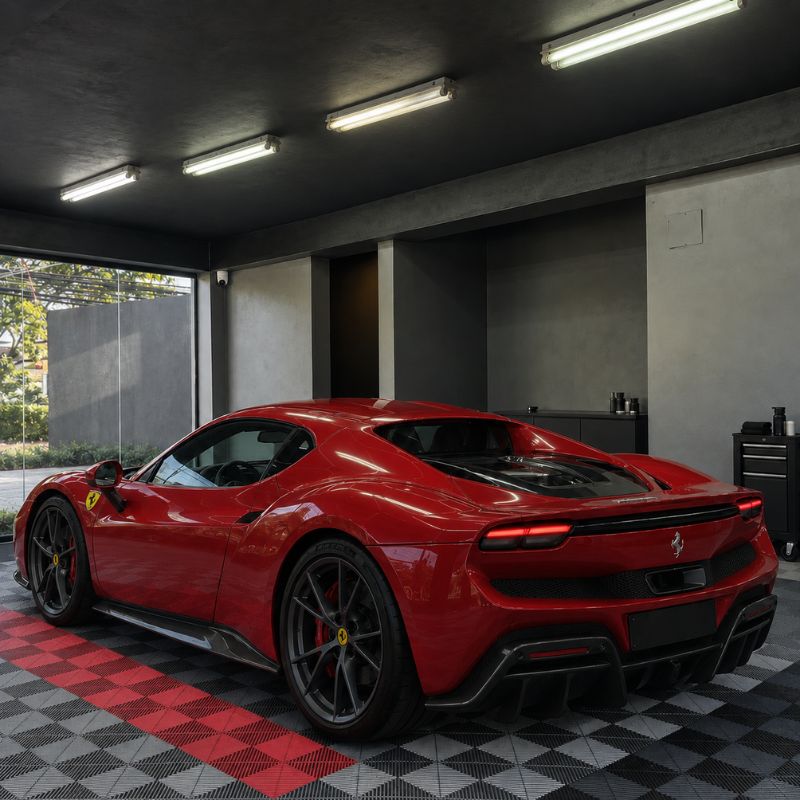
Before: conventional lighting that lights the room without really showing off the vehicle. After: an LED grid concentrated above the vehicle draws the eye immediately and brings out every line of the bodywork.
The lighting for your showroom
Tell us the floor area, the height and where the products sit, and we'll send you back the grid layout.
Frequently asked questions
What dealerships, concept stores and retailers ask us.
0.50 hexagons per m² as a baseline, 0.70 over display areas and in the storefront. A showroom lit evenly everywhere flattens everything: nothing stands out anymore.
Because what makes a product stand out isn't the amount of light, it's the ratio between the product and its background. An object lit two to three times brighter than its surroundings draws the eye, even at a moderate level. Before adding panels above a product, ask whether you should remove some elsewhere instead.
Stand where customers look at the product — usually the entrance — and note what you see reflected in the bodywork. Offset the grid accordingly. Do this check before drilling, not after.
Neutral white for the products: it's what renders their true color. Color comes in as a complement, on a background or an outline, to create atmosphere — never to light the product itself.
The CE marking on the product, the declaration of conformity, the complete datasheet (luminaire output, power, color temperature, CRI), and the warranty period with exactly what it covers.
No, never. Emergency lighting is separate equipment, independent of the normal lighting, with its own inspection requirements. The regulations depend on the type of establishment.
LEDs don't burn out, they gradually lose intensity; it's the power supply that fails first. The real risk is not finding the same reference again: buy one more panel than you need and keep it.
Yes, on a modular grid each panel comes off individually. Check at purchase that panels can be removed without breaking the neighboring connector.
Have a question that's not listed here?
Give us your floor area and ceiling height, and we'll reply with a costed layout.
The Hexeli benchmark
The showroom rule is the opposite of the workshop rule: you don't light the room, you light what you're showing. Everything else should stay in the background, or the eye wanders.
A hexagonal ceiling does two jobs here: it lights, and it becomes a signature visible from the street.
A product lit two to three times brighter than its background stands out immediately. It's the contrast that counts, not the absolute output.
By day it competes with daylight; by night it becomes the only argument. It's the densest zone in the store.
Car bodies, display windows, glossy floors, screens: a showroom is full of surfaces that bounce light back. Check from the customer's viewpoint, never from the middle of the room.
Underline an axis to lead from the entrance to the flagship product, or draw an island of hexagons above a product the way a rug marks the floor: the grid guides as much as it lights.
| Zone | Density | Goal |
|---|---|---|
| Flagship product | 0.70 hex/m² | Draw the eye |
| General display | 0.50 hex/m² | Show without overpowering |
| Circulation | 0.35 to 0.50 hex/m² | Guide |
| Storefront | 0.70 hex/m² and up | Compete with daylight, shine at night |
| Counter, checkout | 0.55 hex/m² | Where people read and sign |
General information: for premises open to the public, have lighting levels and emergency lighting validated by a professional.
View the white kits
French specialist in hexagonal LED lighting. Robust equipment, fair prices, responsive service.
📞 +33 1 84 16 45 42
📧 support@hexeli.com