


French specialist in hexagonal LED lighting. Robust equipment, fair prices, responsive service.
📞 01 84 16 45 42
📧 support@hexeli.com
Workshop, detailing booth, professional garage: here we're not looking for atmosphere, we're looking to see. Slide the handle.
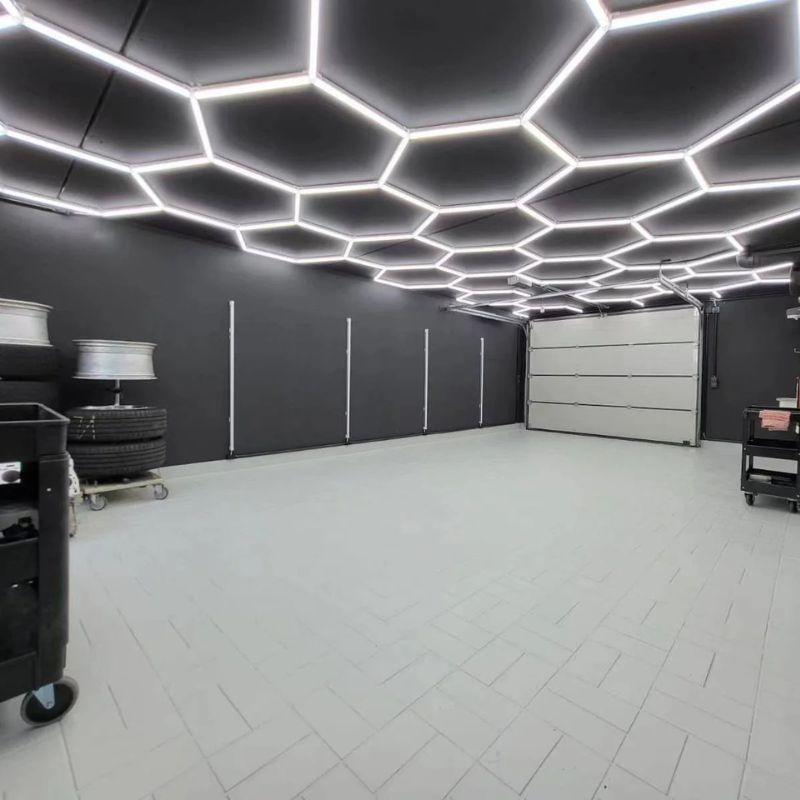
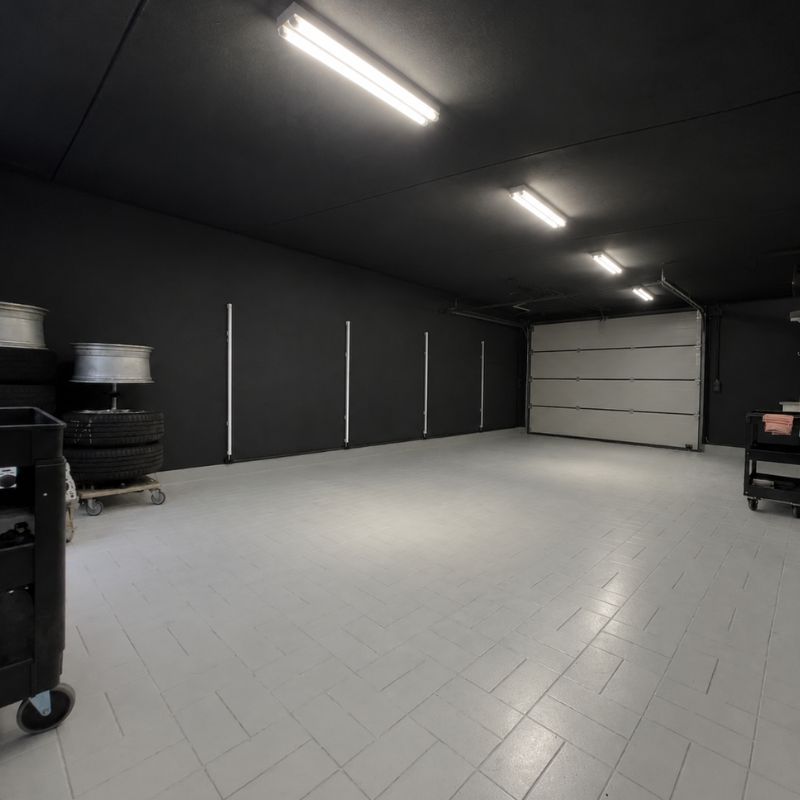
Before: a few neon lights illuminate the floor, but leave the walls and work areas in shadow. After: hexagonal LEDs cast a powerful and even light throughout the workshop.
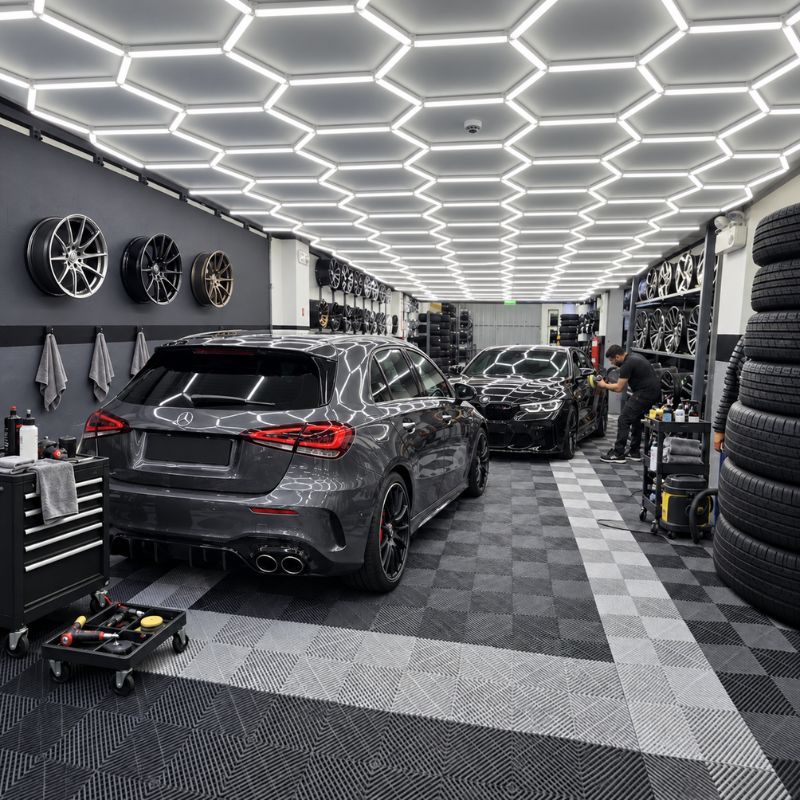
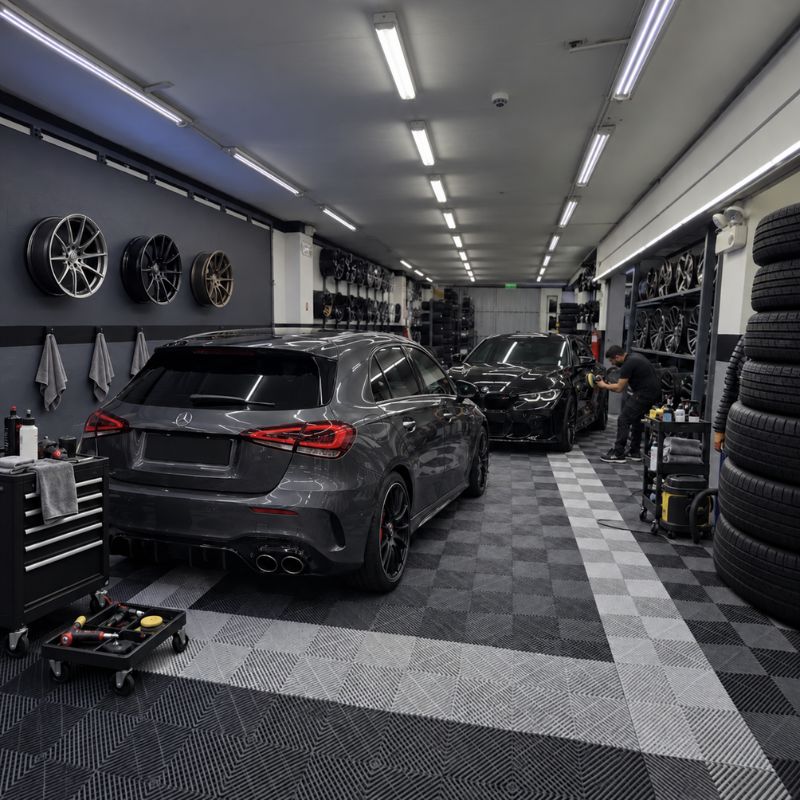
Powerful and uniform lighting throughout the workshop: every detail becomes visible, with no shadows between vehicles.
Your workshop plan
Area, height, number of workstations: we'll send you the number of hexagons and their distribution by zone.
Frequently Asked Questions
Short answers, with a link to the detailed guide.
0.55 hexagons per m² for the base, like a garage. But it goes up to 0.80 per m² in the inspection and detailing areas: that's where finishes are judged.
Because we're not looking for the same thing. In mechanics, you want to see a part. In detailing, you want to see a flaw of a few microns in the clear coat: the light grid needs to reflect densely enough on the bodywork to reveal holograms.
The correct benchmark is not the lumen of the panel but the illuminance at the work surface, in lux: 300 to 500 lux for general work, 750 lux and more for quality control. Watts, on the other hand, mean nothing since LED technology.
No, these are three different problems. The workbench requires light on the work surface without a shadow from the hand; the bridge requires light under the vehicle; the pit requires its own, permanent lighting that does not depend on a portable lamp.
CRI greater than 90. Below this, reds and coppers appear false, and a touch-up might look fine in the garage, but visibly off outdoors.
Yes, but for something else. The weft is the work light; the inspection lamp is the control light, which is brought in at a grazing angle to read a defect. One does not replace the other.
No, but you'll need 50% more panels. Also, consider access for cleaning: at that height, simple maintenance requires a cherry picker or scaffolding.
Dust accumulates on the diffusers, causing a very gradual drop in performance — one doesn't notice it. Plan for annual cleaning with a dry cloth, with the power off. In washdown areas, an appropriate ingress protection rating is required.
Have a question that's not listed here?
Provide us with your floor area and ceiling height, and we'll send you a detailed quote with a plan.
The Hexeli benchmark
A workshop doesn't have one lighting need, it has three: wide vision for moving around, precise vision at the workbench, and accurate vision on a car body. A single uniform light does not achieve all three.
The Hexeli method: a basic density throughout, reinforced in control areas.
0.55 on circulation and routine mechanics, 0.80 on vehicle footprint in detailing and control stations.
The lighting needs to extend one meter around the lifted vehicle, otherwise we're back to using a trouble light as soon as we go underneath.
An CRI higher than 90 is the first criterion on a product sheet. Color temperature comes next. A "CRI" advertised without a number commits to nothing.
The weft lights up for work. The final inspection is carried out at a grazing angle, with an inspection lamp: it's the angle that reveals the defect, not the amount of light.
| Area | Density | What we're looking for |
|---|---|---|
| Traffic, storage | 0.35 to 0.50 hex/m² | To move around, to find |
| Common mechanics | 0.55 Hex/sqm | See the part and tool |
| Vehicle lift | 0.55 hex/sqm + 1 m overhang | See under the vehicle |
| Established | 0.55 hex/sqm, offset weave | No shadow of the hand |
| Detailing, inspection | 0.80 hex/m² | Holograms and clear coat defects |
Add 50% more panels above 3 m in height, and provide access for annual cleaning.
See white kits
French specialist in hexagonal LED lighting. Robust equipment, fair prices, responsive service.
📞 01 84 16 45 42
📧 support@hexeli.com